


What the Numbers Actually Show
Most businesses can point to a server outage or a big system failure and name the cost. What’s harder to see is the slow leak: the fifteen minutes someone spends staring at a frozen screen, the email that sits unread in a support queue, the “I’ll just deal with it later” that turns into an afternoon. A 2023 survey from Electric AI, an IT services company that surveyed 1,049 employed Americans, tried to put a number on exactly that leak, and the number is bigger than most owners would guess.
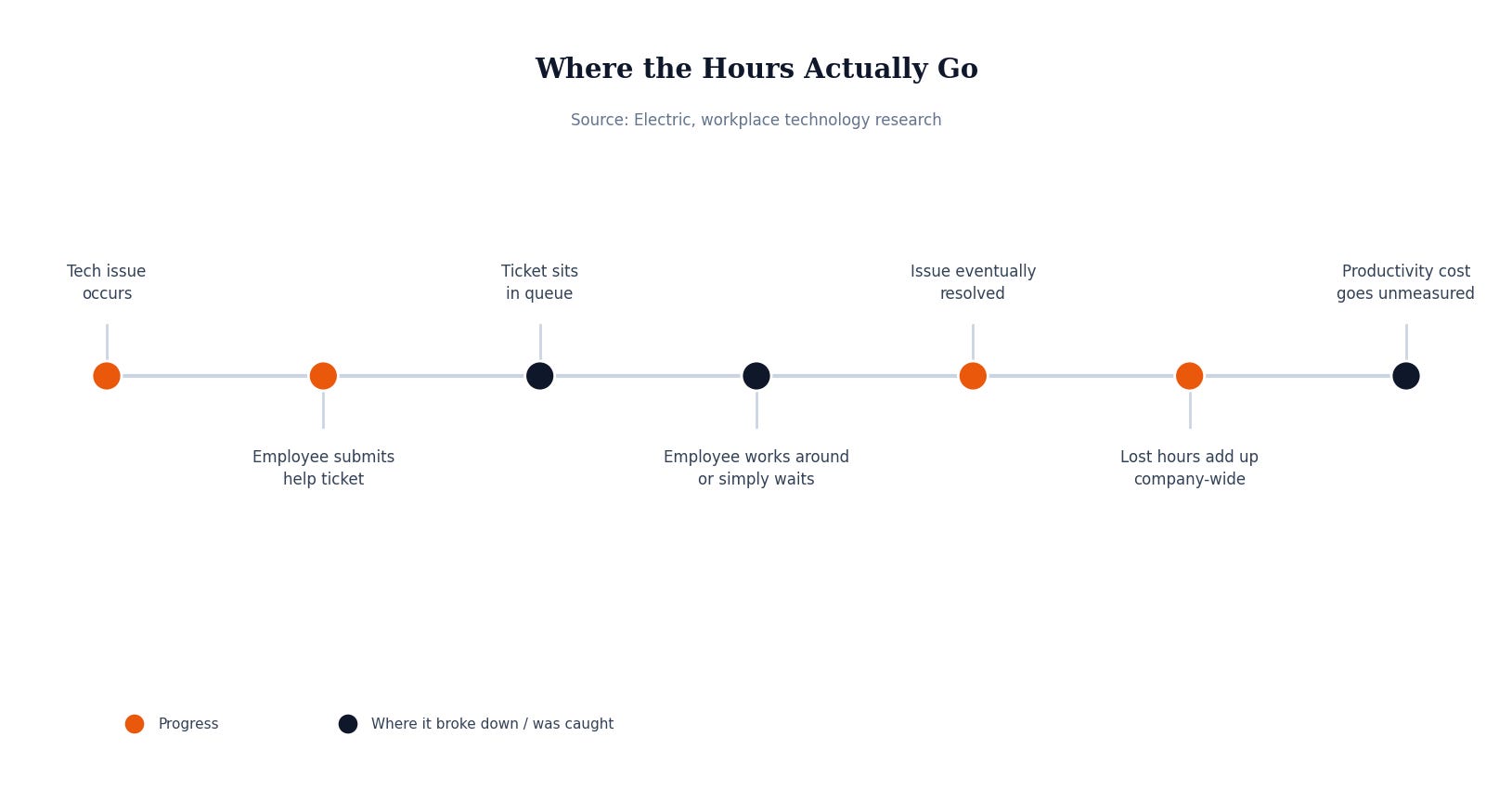
The headline figure: employers waste an average of $4,072 per employee every year because of tech issues. That’s not hardware replacement or software licensing, it’s the cost of paid time spent waiting, troubleshooting, and working around problems instead of working. Respondents said they spend almost three hours a week dealing with tech issues, which the survey calculated out to more than 140 hours a year, roughly three and a half work weeks, per employee, gone.
The survey also found the pain isn’t evenly distributed. Remote workers reported the highest rate of wasted time from tech problems, 73%, compared with 41% of hybrid employees and 22% of employees working fully on-site, a gap that tracks with how much harder it is to get quick, in-person help when you’re not in the building. More than half of respondents, 55%, described their company’s technology as outdated, and less than half said their company’s IT support actually resolved their issues effectively when they asked for help.
One more finding is worth pulling out on its own: when official IT support is slow or absent, the burden doesn’t disappear, it shifts to coworkers. The survey found that a majority of younger workers specifically felt that being constantly asked for tech help by colleagues held back their own work. In other words, when there’s no reliable place to send a tech problem, it doesn’t get solved faster. It just gets handed to whoever’s desk is closest, and now two people are stuck instead of one.
Why This Matters If You’re Not a Big Company
Do that math against a real team. A twenty-person company losing even half of that $4,072-per-employee figure, roughly $2,000 a person, is looking at $40,000 a year quietly draining out of productivity nobody put on a budget line. A larger company can absorb that in a rounding error. A twenty-person company feels it in missed deadlines, in a project that always seems to be a week behind, in the same three people fielding “can you look at this real quick” questions all day instead of doing their actual jobs.
This is exactly where being small or mid-size makes the problem worse, not better. Big companies have a dedicated help desk with a ticketing system, defined response times, and staff whose whole job is making tech problems go away quickly. Most small and mid-size businesses don’t. Instead, IT support is whoever’s good with computers, handled between their real responsibilities, or it’s a break-fix vendor you call after something’s already broken and then wait on. Both setups mean the fifteen-minute problem realistically takes an hour or a day to actually get resolved, and that gap compounds every single week.
What Businesses Should Do Instead
The fix isn’t more technology, it’s a faster, more reliable path to a fix when something goes wrong. That means a real point of contact for IT issues with an actual response-time expectation attached to it, not “someone will get to it eventually.” It also means proactively replacing the technology the survey flagged as the biggest drag, aging, outdated equipment, on a planned schedule rather than waiting for it to fail mid-task.
It also means measuring this at all. Most small businesses have never tracked how much time their team actually loses to tech problems in a given month, which is exactly why it’s easy to underestimate. A managed IT provider with defined response-time commitments turns that guesswork into a number you can see, and gives your team someone to call other than the coworker at the next desk.
Security Checklist for Your Business
Set a real response-time standard. Define how fast a tech issue should get acknowledged and resolved, and hold whoever handles IT, internal or outsourced, to it.
Track the hours, not just the tickets. Ask your team occasionally how much time tech issues actually cost them in a week; most owners are surprised by the answer.
Replace aging equipment on a schedule. Don’t wait for old hardware to fail mid-task; a planned refresh cycle is cheaper than the downtime it prevents.
Give employees one clear place to go. A defined IT contact, not “ask whoever’s nearby,” keeps the burden off your most tech-savvy staff and gets issues fixed faster.
Three hours a week per employee doesn’t sound like much until you multiply it across a whole team and a whole year. MSP Today’s trusted tech partner is JK Computer Solutions. If you want a second set of eyes on your setup, get in touch.
Source: Electric AI, “Wasted Talent: Time Lost to (Old) Tech Issues”.