

What the Data Shows
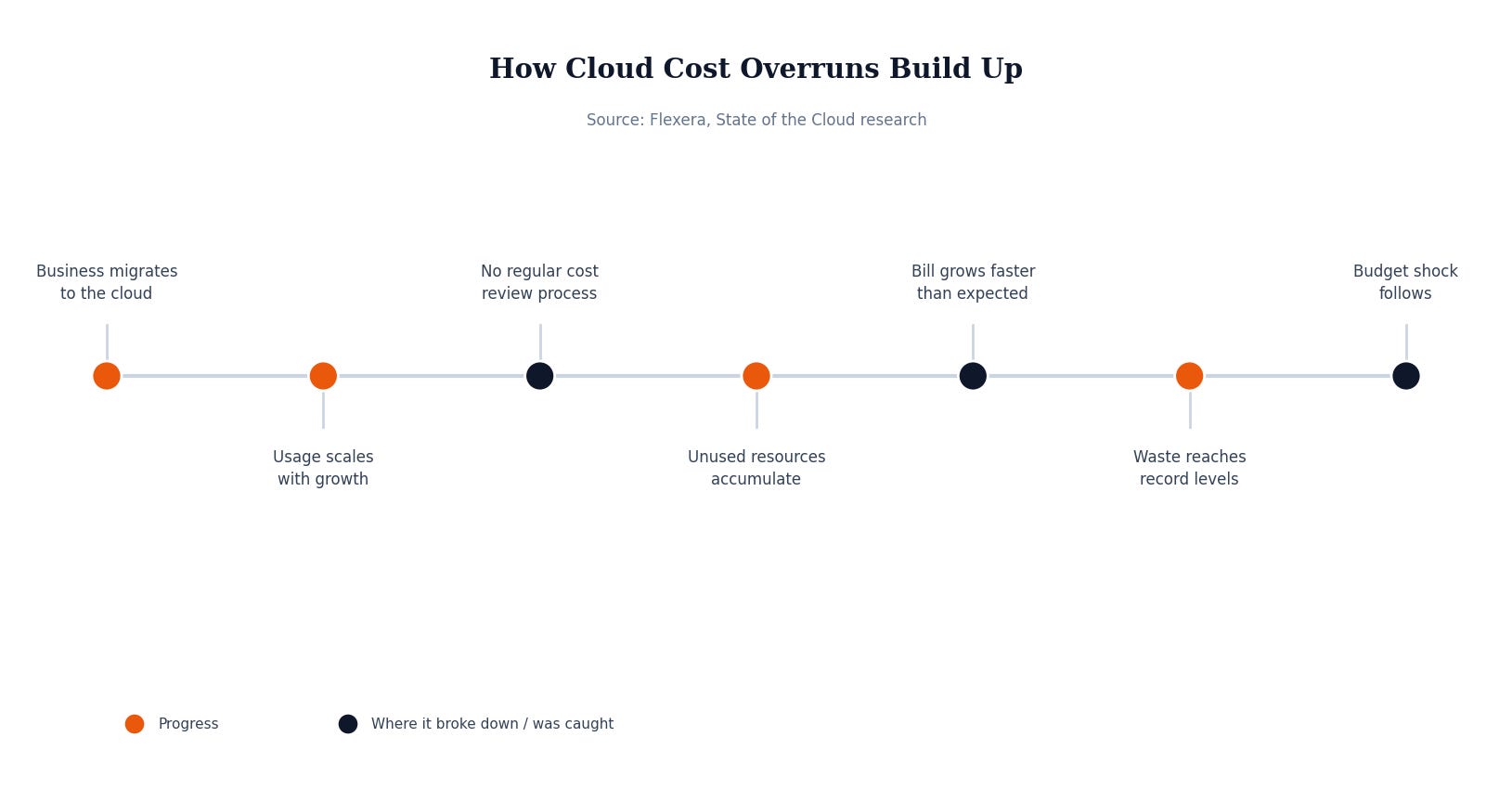
Every year, Flexera surveys IT and finance leaders for its State of the Cloud Report, and for five years running, the trend line on wasted cloud spend had been heading in the right direction. That streak broke in the 2026 report: estimated wasted cloud spend on infrastructure and platform services (IaaS and PaaS) climbed to 29%, the first increase in five years. In plain terms, almost a third of the money organizations are putting into cloud infrastructure is going toward resources that deliver nothing back — unused capacity, oversized instances, orphaned storage, and services nobody remembered to turn off.
The report ties the reversal directly to how fast AI adoption is moving. Cloud-based AI workloads are surging, and Flexera notes that “AI workloads behave differently than traditional cloud services, making visibility, governance and financial controls harder — but more essential — than ever.” Teams are standing up GPU-heavy workloads, new PaaS and SaaS tools, and experimental AI projects faster than their existing cost-tracking processes can keep up with, and the waste number is the receipt.
It’s not a new problem, just a worsening one. Flexera’s 2021 report already found organizations running over their public cloud budgets by an average of 24%, with wasted spend estimated around 30% even then. What’s changed is the scale: the 2026 report found 76% of large enterprises now spend more than $5 million a month on cloud services, meaning even a modest percentage of waste translates into real money fast. And across company sizes, 85% of respondents said managing cloud spend is their top challenge — ahead of security and ahead of managing software licenses, which is a notable thing for an industry that spends a lot of energy talking about security first.
None of this requires a breach, an outage, or a single dramatic “bill shock” headline to matter. It’s the slow, unglamorous kind of cost problem: nobody sets out to waste 29% of a cloud budget, it just accumulates one un-monitored resource, one forgotten test environment, and one “we’ll clean that up later” at a time.
Why This Matters If You’re Not a Big Company
It’s easy to read “$5 million a month” and assume this is purely an enterprise problem. It isn’t. The mechanics that produce that 29% waste figure — resources provisioned and never right-sized, services left running after a project ends, nobody clearly owning the monthly cloud bill — show up at any scale. A 20-person company running its email, backups, line-of-business software, and a couple of AI-powered tools in the cloud can waste the same percentage of its budget as a Fortune 500 company; it’s just a smaller number that’s easier to not notice, because nobody’s finance team is scrutinizing a $400 monthly overage the way they would a $400,000 one.
That’s actually the more dangerous version of the problem for a small or mid-size business. A big enterprise has a FinOps team whose entire job is watching this. A smaller business usually doesn’t have anyone watching it at all — the cloud bill just gets paid, and it creeps up a little every renewal cycle without anyone asking why. Multiply “managing cloud spend is our top challenge” (which 85% of organizations of every size said) by a business with no dedicated person tracking it, and the waste doesn’t get caught until someone finally looks at a year of invoices side by side.
What Businesses Should Do Instead
The fix isn’t exotic — it’s the same governance discipline Flexera’s report points to, just scaled down to fit a smaller IT footprint. Start with a straightforward inventory: what cloud and SaaS services are you actually paying for right now, and does someone specific own reviewing that list on a schedule? Most cloud waste isn’t malicious or even careless in the moment — it’s a resource that made sense when it was set up and was never revisited. A quarterly review that asks “do we still need this, and is it sized right” catches most of it.
Pair that with basic alerting. Every major cloud provider offers budget alerts and cost anomaly detection at little or no extra cost — the tools exist, they’re just frequently never turned on. And before adding new cloud or AI tools, it’s worth asking the boring question up front: who is responsible for this bill going forward, and where does it get reviewed? That single ownership question prevents more waste than almost any tool.
Security Checklist for Your Business
Inventory every cloud and SaaS subscription. List what you’re actually paying for and assign someone to review it quarterly.
Turn on budget alerts and anomaly detection. Most cloud providers include this at no extra cost — it just has to be switched on.
Right-size and retire unused resources. Oversized instances, idle test environments, and orphaned storage are the most common sources of waste.
Name an owner for every new cloud or AI tool. Before adopting anything new, decide who reviews its cost and usage going forward.
Cloud waste rarely announces itself with a single bad bill — it builds quietly until a year of invoices tells the real story. MSP Today’s trusted tech partner is JK Computer Solutions. If you want a second set of eyes on your setup, get in touch.
Source: Flexera, “Flexera Finds Cloud Value is Rising While AI Waste Grows”.