

What Happened
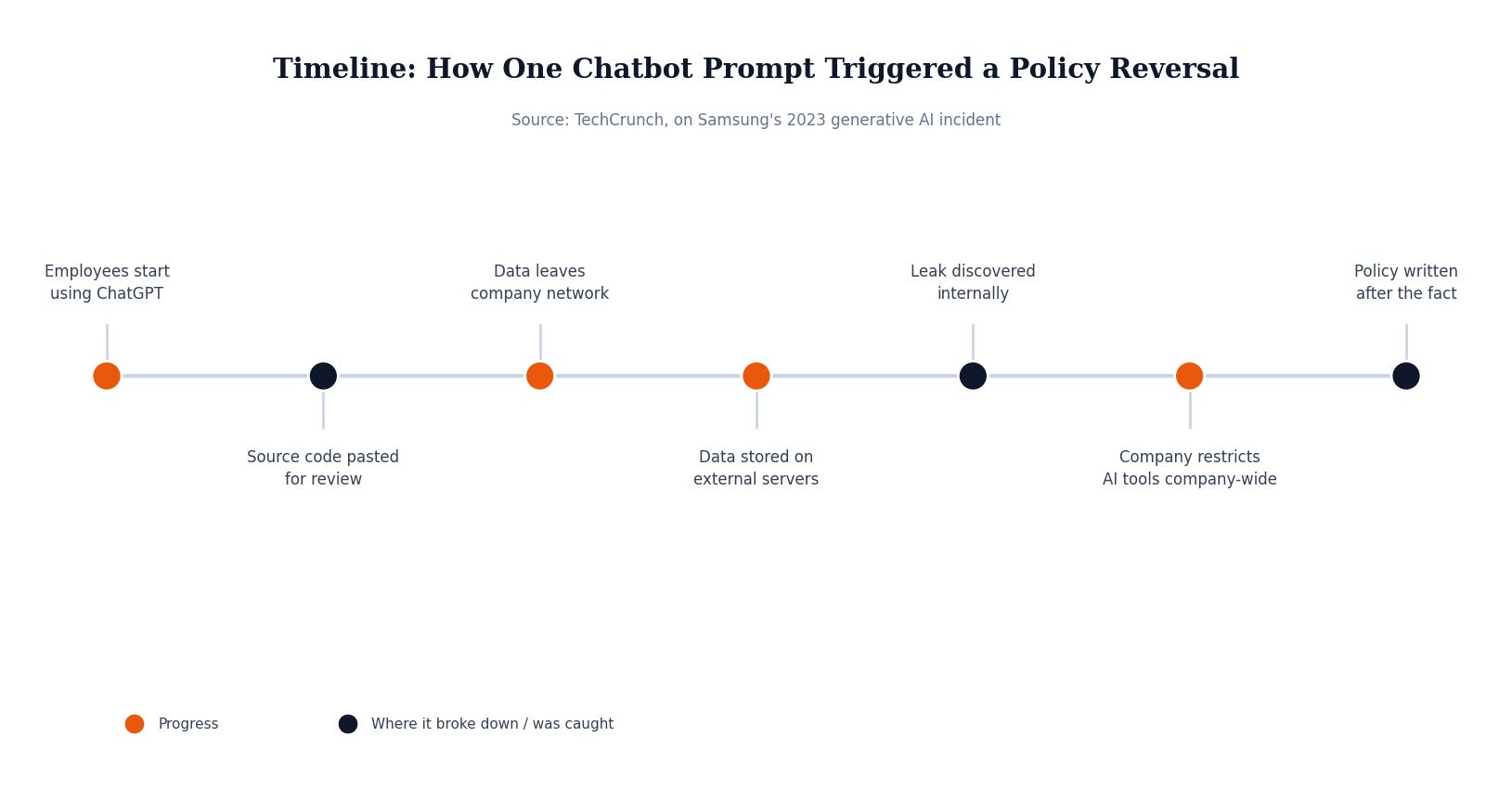
In April 2023, Samsung employees ran into the same problem millions of office workers now face every day: a tedious task and a chatbot that promised to make it faster. According to reporting from TechCrunch, three separate Samsung employees used ChatGPT for work tasks and, in doing so, accidentally leaked internal, sensitive company data to the service, none of it done with any intent to cause harm, just people trying to get through their day.
The specifics of each incident were never fully disclosed publicly, but the pattern was clear enough: internal, proprietary information ended up inside a public AI tool that Samsung did not control, could not retrieve data from, and had no visibility into once it was submitted. That is the core problem with tools like ChatGPT in a business setting. Once information is typed into the prompt box, it has effectively left the building.
Samsung’s response was fast and blunt. On May 1, 2023, the company issued an internal memo temporarily restricting the use of generative AI tools, not just ChatGPT but any service built on similar technology, including Microsoft’s Bing chatbot and Google’s Bard. The restriction applied to company-owned computers, tablets, and phones, and even extended to personal devices connected to Samsung’s internal network. Samsung told employees the ban would stay in place until it built internal safeguards, and the company began developing its own in-house AI tools for tasks like software development and translation as a controlled alternative.
What makes this case worth studying isn’t the scale of Samsung’s operation, it’s how ordinary the setup was. No hacker, no phishing email, no exploited vulnerability. Just employees using a tool that was freely available, genuinely useful, and completely outside any policy or technical control the company had in place at the time.
Why This Matters If You’re Not a Big Company
It’s tempting to read this as a Samsung-sized problem: a company with proprietary chip designs and enormous trade secrets to protect. But the mechanism here has nothing to do with company size. Any employee at any business can open ChatGPT in a browser tab and paste in a client contract to summarize it, a spreadsheet of customer data to reformat it, or an email thread to help draft a reply. Nothing about that requires Samsung’s scale, and nothing about it requires malicious intent.
Small and mid-size businesses are arguably more exposed to this, not less. Larger companies at least have IT and security teams that can build the kind of internal AI alternative Samsung did. Most smaller businesses have neither the policy nor the tooling in place, which means employees are left to make their own judgment calls about what’s safe to paste into a chatbot, one prompt at a time, with no guardrails and no one checking. If your business handles client contracts, financial records, health information, or anything else you wouldn’t want sitting on a third party’s servers indefinitely, that risk exists the moment an employee has both that data and a browser open.
What Actually Would Have Stopped This
The fix isn’t banning AI outright, and Samsung itself didn’t land there either; it treated the ban as temporary while it built a safer path forward. The real fix is having a written policy, before an incident happens, that spells out what categories of data (client information, financial records, source code, anything under an NDA) are off-limits to paste into public AI tools, and making sure every employee actually knows that policy exists. A policy nobody has read protects nobody.
Beyond policy, there are real technical options: enterprise AI plans that contractually exclude your data from model training, browser or network-level controls that can flag or block sensitive data leaving the network, and simply steering employees toward approved tools instead of leaving them to find their own. None of this requires Samsung’s engineering resources. It requires deciding, in advance, what’s off-limits and telling people clearly.
Security Checklist for Your Business
Write an AI usage policy. Spell out exactly what data (client records, financials, anything under NDA) is never to be pasted into public AI tools, and share it with everyone, not just IT.
Offer an approved alternative. Employees turn to public tools because they’re useful; give them an enterprise or business-tier AI option with proper data protections instead of leaving them to freelance it.
Train people on the “why,” not just the rule. A short explanation of how public AI tools store and use submitted data makes the policy stick better than a rule with no context.
Review what’s already out there. If you suspect sensitive data may already have been pasted into a public tool, treat it like any other data exposure and assess what was shared and what it affects.
Samsung had the resources to react within days and build its own controlled alternative. Most businesses won’t move that fast unless the policy and the tools are already in place before someone hits “send.” MSP Today’s trusted tech partner is JK Computer Solutions. If you want a second set of eyes on your setup, get in touch.
Source: TechCrunch, “Samsung bans use of generative AI tools like ChatGPT after April internal data leak”.