

A Decade of Warnings, Then a Total Meltdown
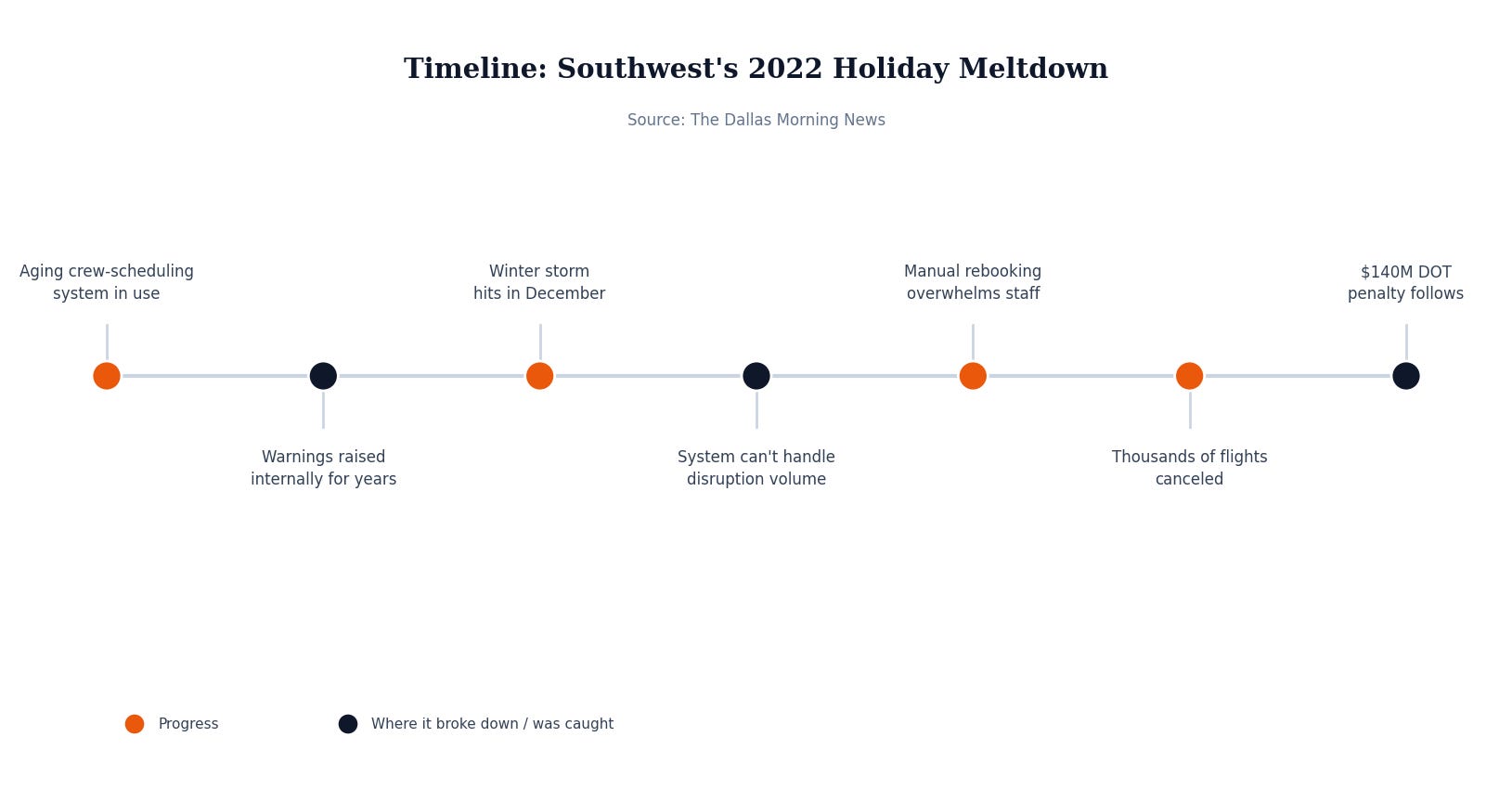
When a winter storm swept the central United States the week before Christmas in 2022, airlines across the country scrambled to reroute crews and rebook passengers. Every major carrier weathered it. Southwest Airlines did not. Over ten days, the airline cancelled roughly 16,700 flights, stranding crews and passengers nationwide in what became one of the worst operational failures in U.S. airline history. The proximate cause, according to Southwest’s own leadership, was crew-scheduling software that simply could not keep pace once the number of reassignments needed spiked past what the system was built to handle.
What made the story bigger than one bad week of weather was the paper trail behind it. A Dallas Morning News investigation traced more than a decade of warning signs that Southwest’s technology was falling behind: a 2011 telecommunications and loyalty-program failure, a 2015 crew-scheduling breakdown during a Chicago snowstorm that drew a $1.6 million Department of Transportation fine, a single router failure in 2016 that cascaded into 2,300 cancellations and cost the airline an estimated $54 million in lost revenue and added expenses, and repeated reservation-system outages through 2021. Union leaders representing pilots, flight attendants, and ground crews had been raising the same complaint for years: the systems running the airline’s day-to-day operations were old, patched together, and not being replaced fast enough.
Southwest’s own executives acknowledged this pattern on the record, well before December 2022. In 2017, then-Chief Operating Officer Mike Van de Ven told reporters, “to be real blunt, up until about 2010, it all worked pretty well… we’re at that point that we need to make some investments.” In late 2021, incoming CEO Bob Jordan said employees lacked the tools to manage operational complexity and that the airline needed to modernize. Those were not hidden concerns; they were public statements about known gaps, made a year and five years, respectively, before the gaps caused a nationwide meltdown.
The financial reckoning came fast. Southwest ultimately committed to spending $1.3 billion annually on IT upgrades starting in 2023, on top of $500 million already spent on a 2017 reservation-system overhaul and $2 billion committed in mid-2022 for other technology upgrades. The company also faced a $140 million civil penalty from the Department of Transportation over the meltdown, on top of the direct costs of rebooking, refunds, and reputational damage. None of that spending had to happen on an emergency timeline. It could have happened years earlier, at a fraction of the cost of a crisis response.
Why This Matters If You’re Not a Big Company
It’s tempting to read a story about a major airline and assume it doesn’t apply to a 30-person company running a couple of on-site servers. But the mechanism is identical, just at a different scale. Southwest didn’t fail because one system was old; it failed because years of “we’ll get to it next budget cycle” decisions compounded until an ordinary stress event, a winter storm, hit systems that no longer had the headroom to absorb it. Small and mid-size businesses make that exact same trade-off every year when a server, firewall, or backup appliance quietly ages past its support window and nobody re-evaluates the risk because it’s “still running fine.”
The difference is that a small business doesn’t get a decade of near-misses and public warnings before the bill comes due, and it doesn’t have $1.3 billion a year to throw at a crisis fix. When aging hardware finally fails, or an unsupported system finally gets exploited, most small businesses are looking at days of downtime, lost customer trust, and a scramble to replace equipment on the worst possible timeline, all at once, with no warning window to plan around.
What Actually Would Have Stopped This
The fix here isn’t exotic. It’s a documented hardware and software lifecycle plan, reviewed on a regular schedule, that treats “still running” as a different question from “still supported and still able to handle load.” Servers, network hardware, and line-of-business systems should have a known refresh date tied to vendor end-of-support dates, not to whether they happen to still boot. Southwest’s own history shows the cost of skipping this: a single aging router failure in 2016 cascaded into a multi-day, $54 million crisis, and it still took another six years and a much larger meltdown before the spending actually happened.
Just as important is treating internal warnings the way Southwest’s union leadership was treated: as data, not noise. If the people closest to the systems, IT staff, an MSP, or frontline employees, are flagging that equipment is aging out or struggling under normal load, that’s the signal to budget for a refresh before a storm, a traffic spike, or an attacker forces the issue on someone else’s timeline.
Security Checklist for Your Business
Track support end dates, not just uptime. Know exactly when every server, firewall, and network device loses vendor support, and budget its replacement before that date, not after something breaks.
Treat single points of failure as unacceptable. A single aging router or server took down thousands of Southwest flights in 2016; identify anything in your environment with no backup or failover path.
Listen to your own team’s warnings. If staff or your IT provider have flagged aging or struggling systems more than once, that’s a budget item, not a recurring complaint to note and move past.
Plan refreshes on a schedule, not a crisis. A predictable three-to-five-year hardware refresh cycle costs far less, and causes far less disruption, than replacing everything at once after a failure.
Southwest’s meltdown didn’t start with the weather; it started with years of technology decisions that kept getting pushed to next year. MSP Today’s trusted tech partner is JK Computer Solutions. If you want a second set of eyes on your setup, get in touch.
Source: The Dallas Morning News, “Southwest Airlines’ December meltdown came after years of tech failures”.